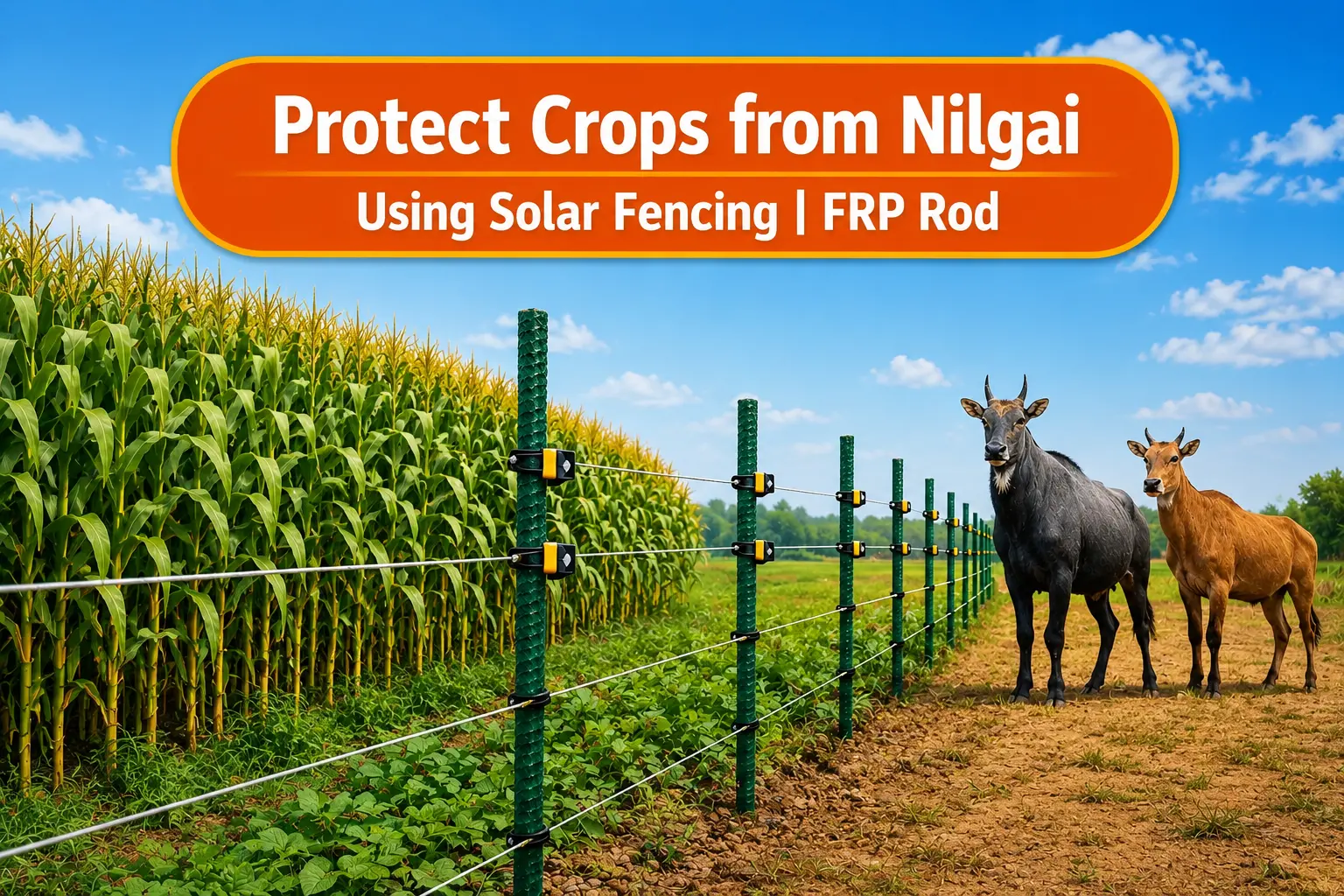
Nilgai (Blue Bull), wild animals and stray cattle are one of the biggest reasons for crop loss in many farming regions of India. Farmers growing watermelon, maize and wheat often face heavy losses when animals enter the farm at night and destroy crops. Nilgai can damage a full farm in a single night, especially vegetable and fruit crops.
The most effective solution for crop protection is solar fencing with FRP fencing rods, which creates a safe electric boundary around the farm and prevents animals from entering the field.
Nilgai crop damage is very common in Madhya Pradesh, Gujarat and Rajasthan. Farmers in these states face major crop losses every year due to wild animals.
Farmers in these regions grow crops like watermelon, maize, wheat, soybean and vegetables which are highly affected by Nilgai and wild animals.
Solar fencing works by sending a mild electric pulse through fencing wires. When animals touch the fence, they receive a small shock and stay away from the farm boundary. After a few attempts, animals stop coming near the farm.
Solar fencing system includes solar energizer, fencing wires, insulators and FRP fencing rods which are used as fence support poles.

FRP (Fiber Reinforced Plastic) rods are a good fencing pole choice for agriculture solar fencing. Compared to iron poles and cement poles, FRP rods can last longer and need less maintenance.
FRP rods are widely used in agriculture for multiple applications:
Solar fencing using FRP rods is very useful for protecting the following crops:
FRP rods are lightweight, rust free, easy to install and reusable, while cement poles are heavy and iron poles rust over time. FRP rods require very low maintenance and are ideal for long-term solar fencing projects.
Solar fencing using FRP rods is one way to protect crops from Nilgai and wild animals in Madhya Pradesh, Gujarat and Rajasthan. FRP rods provide long life, low maintenance and easy installation, making them ideal for farm fencing and crop protection applications. Farmers growing watermelon, maize and wheat can help protect their crops using solar fencing supported by FRP rods.