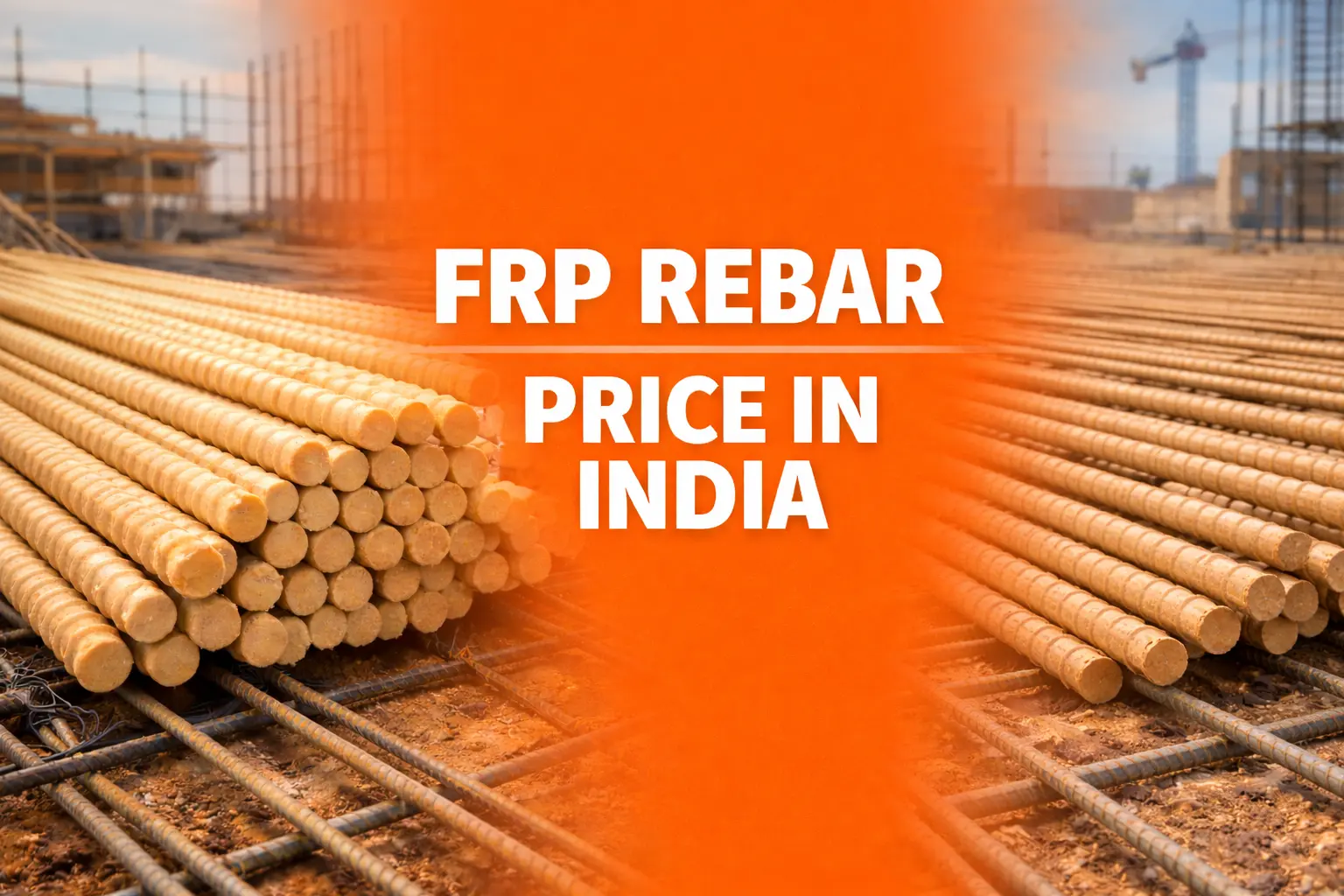
As modern construction projects demand materials that last longer and require less maintenance, FRP rebar is gaining attention across India. Contractors, engineers, and infrastructure developers are increasingly exploring fiberglass reinforcement bars as an alternative to traditional steel reinforcement.
One of the most common questions people ask before switching to fiberglass reinforcement is simple: What is the price of FRP rebar in India? In this guide, we explain the factors that affect FRP rebar cost, typical sizes available in the market, and how the price compares with traditional steel reinforcement.
FRP rebar stands for Fiber Reinforced Polymer reinforcement bar. It is manufactured using high-strength fiberglass fibers embedded inside a polymer resin matrix. This structure creates a reinforcement bar that is lightweight, corrosion resistant, and extremely strong.
Unlike steel rebars, FRP bars do not rust when exposed to moisture or chemicals. This makes them particularly useful in coastal construction, industrial environments, and infrastructure projects where corrosion can damage steel reinforcement over time.
To check current options, send your requirement and get a verified quote.
FRP reinforcement bars are available in multiple diameters depending on the structural requirement of the project. Smaller bars are used for light reinforcement while larger diameters are used in heavy structural applications.
| Diameter | Common Application |
|---|---|
| 6mm - 8mm | Light reinforcement and precast structures |
| 10mm - 12mm | Slabs, foundations and flooring |
| 16mm - 20mm | Structural reinforcement and infrastructure projects |
Larger diameter FRP bars require more fiberglass and resin during manufacturing. As a result, thicker reinforcement bars usually cost more compared to smaller sizes.
The quality of fiberglass used in production directly impacts the strength and durability of the rebar. High-grade fiberglass can increase the cost slightly but also improves long-term structural performance.
The polymer resin used during manufacturing determines chemical resistance and durability. Special resins designed for aggressive environments such as marine construction can increase the overall cost of FRP rebars.
Large construction projects often purchase reinforcement materials in bulk quantities. In such cases, the price per meter or per ton may become lower compared to small retail orders.
At first glance, FRP rebar may appear slightly more expensive than traditional steel reinforcement. However, when long-term maintenance costs are considered, FRP rebars can provide better value.
Steel rebars can corrode over time when exposed to moisture, chloride salts, or chemicals. This corrosion causes cracks in concrete and eventually leads to costly repairs. FRP rebars, on the other hand, are corrosion resistant and require minimal maintenance throughout the life of the structure.
For a deeper technical comparison, read our guide on FRP Rebar vs Steel Rebar.
In recent years, the use of fiberglass reinforcement bars has expanded rapidly across many infrastructure and industrial projects in India. Some of the common applications include:
Because FRP rebars do not rust and are lightweight, they simplify transportation and installation on construction sites.
The price of FRP rebar in India depends on several factors such as diameter, fiber quality, resin type, and order quantity. While the initial material cost may sometimes be higher than steel reinforcement, the long-term benefits of corrosion resistance and reduced maintenance often make FRP rebars a more economical solution.
Looking for FRP products? Send your requirement to get a verified quote, or browse the products listed on Dukanix.