
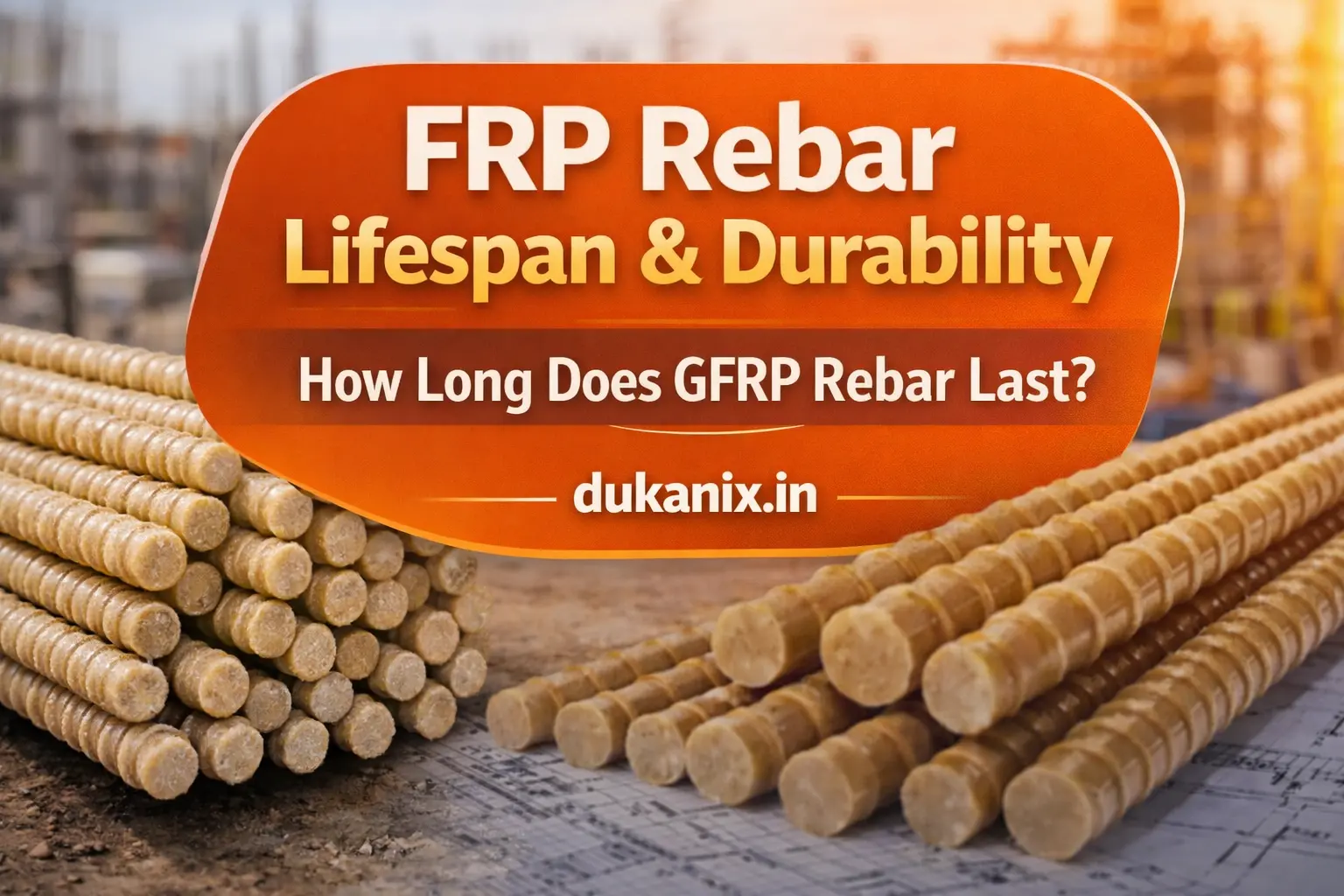
How Long Does FRP Rebar Last?
GFRP rebar is designed for service lives of 50 years and beyond in standard concrete construction environments. In aggressive environments — coastal exposure, water infrastructure, chemical-exposure industrial structures — GFRP's durability advantage over steel is most significant, because the corrosion mechanism that limits steel reinforcement's effective service life does not apply to GFRP.
Understanding GFRP durability requires separating two questions: how the material behaves in alkaline concrete environments over time, and how it performs in the external environments the structure is exposed to.
Sourcing GFRP Rebar for an MP Project?
Dukanix is based in Dhar, MP - your closest wholesale GFRP supplier. Get bulk pricing for your city within 24 hours.
GFRP Rebar in the Alkaline Concrete Environment
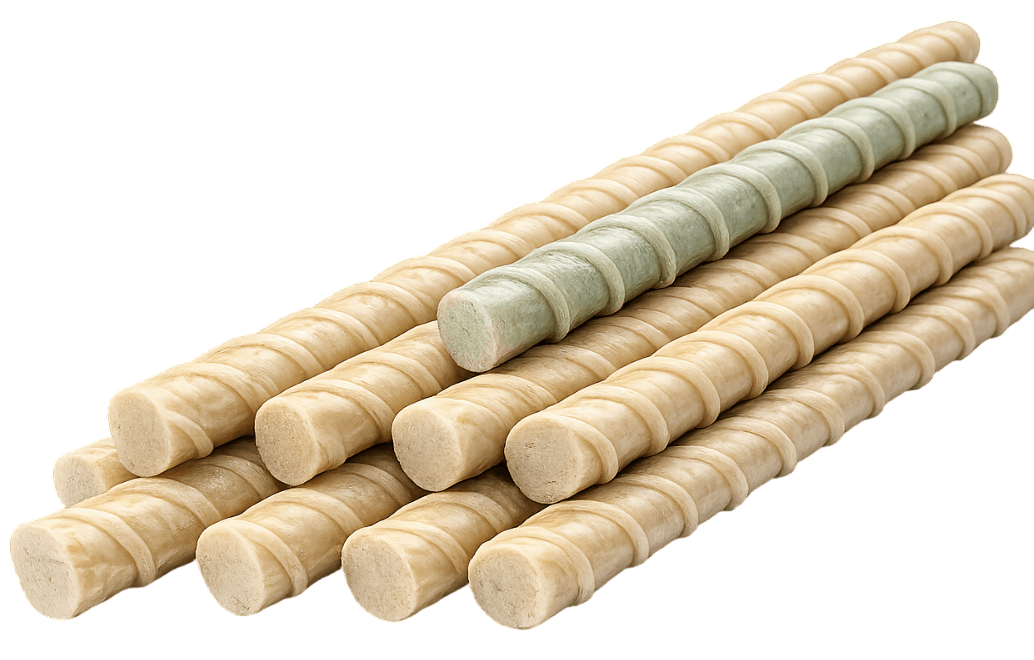
Concrete has a high pH — typically 12.5 to 13.5 when fresh. Early concerns about GFRP durability focused on whether alkaline pore water in concrete would degrade the glass fibres over time. Research and field performance data from structures built in the 1970s and 1980s have established that modern GFRP bars using vinyl ester or modified polyester resin perform reliably in concrete alkaline environments without significant fibre degradation over multi-decade service periods.
The resin matrix surrounding the glass fibres acts as a protective barrier against alkaline pore water. The quality and thickness of this resin coating is the primary determinant of long-term alkali resistance — which is why resin type selection matters for structural applications.
Key Factors That Affect GFRP Rebar Lifespan
Resin type and quality
Vinyl ester resin provides superior alkali resistance and chemical resistance compared to standard polyester resin. For structural applications in aggressive environments, vinyl ester GFRP bars are specified precisely because of this long-term durability advantage. The resin quality and manufacturing process consistency directly affect the bar's service life performance.
Concrete cover depth
Adequate concrete cover protects GFRP bars from external chemical environments and UV exposure during the structure's service life. In most structural applications, the same cover depths used for steel provide more than adequate protection for GFRP — though reduced cover can sometimes be justified because the corrosion-driven cover requirements for steel do not apply.
Temperature exposure
GFRP bars perform well across standard construction temperature ranges. Sustained high temperatures above 60°C can affect the resin matrix — relevant for industrial structures near heat sources or in climates with extreme ambient temperatures. Standard civil and building construction environments in India are well within the acceptable operating range for GFRP.
UV exposure
Uncoated GFRP bars degrade when exposed to prolonged UV radiation before being embedded in concrete. Bars should not be stored in direct sunlight for extended periods before use. Once embedded in concrete, UV is not a durability factor.
GFRP Lifespan vs Steel Rebar in Different Environments
Standard ambient environments
In standard above-grade building structures with adequate concrete cover and no aggressive chemical exposure, high-quality steel rebar can achieve 50-year design lives when correctly specified and constructed. GFRP bars in the same conditions also achieve 50+ year performance. The advantage of GFRP in standard environments is that it eliminates the consequence of construction defects — thin cover, honeycombing, or permeable concrete — that would allow corrosion to initiate in steel-reinforced structures.
Coastal and marine environments
In coastal environments with salt-air and chloride exposure, steel rebar lifespan in concrete is significantly reduced — corrosion initiation in inadequately protected coastal structures can occur within 5–10 years. GFRP bars are unaffected by chloride exposure — there is no chloride threshold, no depassivation mechanism, and no corrosion regardless of chloride concentration. GFRP-reinforced coastal structures maintain their structural integrity across their full design life.
Water and chemical exposure environments
In continuously wet environments — water treatment, drainage, sewage, irrigation — steel rebar service life is typically 15–25 years before corrosion-driven repair is required. GFRP bars in these environments show no equivalent degradation mechanism. Field data from GFRP-reinforced water infrastructure constructed in the 1990s confirms continued structural performance 30+ years after construction without corrosion-related intervention.
Industrial chemical exposure
In industrial environments with acid, alkali, or solvent exposure, steel rebar lifespan depends heavily on concrete quality and exposure intensity. GFRP bars — particularly vinyl ester resin — maintain chemical resistance across a wide range of industrial exposure conditions, making them a long-life reinforcement option where steel performance is uncertain.
Design Life Specifications for GFRP
Several international design standards and guidelines provide GFRP rebar design life guidance:
- ACI 440.1R (USA) — covers design and construction with GFRP bars; used as reference in Indian practice
- CSA S806 (Canada) — design and construction of building structures with fibre-reinforced polymers
- fib Bulletin 40 (Europe) — FRP reinforcement in RC structures
These standards provide environmental reduction factors that account for long-term durability in different exposure conditions — confirming that GFRP is a recognised structural reinforcement material with codified design life provisions.
Conclusion
GFRP rebar is designed for 50-year and longer service lives in concrete structures. Its durability advantage over steel is greatest in aggressive environments — coastal, water infrastructure, chemical exposure, and below-grade applications — where steel corrosion limits effective service life well before the structure's design life is reached. In these environments, GFRP's corrosion-free performance is not just a material property but a lifecycle cost and structural reliability benefit.
Explore our FRP Construction Bars or contact our team for specification guidance and bulk pricing.
Frequently Asked Questions
Quick answers related to this article.
Sourcing GFRP Rebar for an MP Project?
Dukanix is based in Dhar, MP - your closest wholesale GFRP supplier. Get bulk pricing for your city within 24 hours.
Related Blogs
How to Protect Crops from Nilgai Using Solar Fencing | FRP Rod Farm Fencing
03 Apr 2026
Read Article
How to Install FRP Rebar: Step-by-Step Guide for Construction Projects
21 Mar 2026
Read Article
FRP Rebar for Industrial Construction: GFRP Bars for Factories, Warehouses and Plants
18 Mar 2026
Read Article