
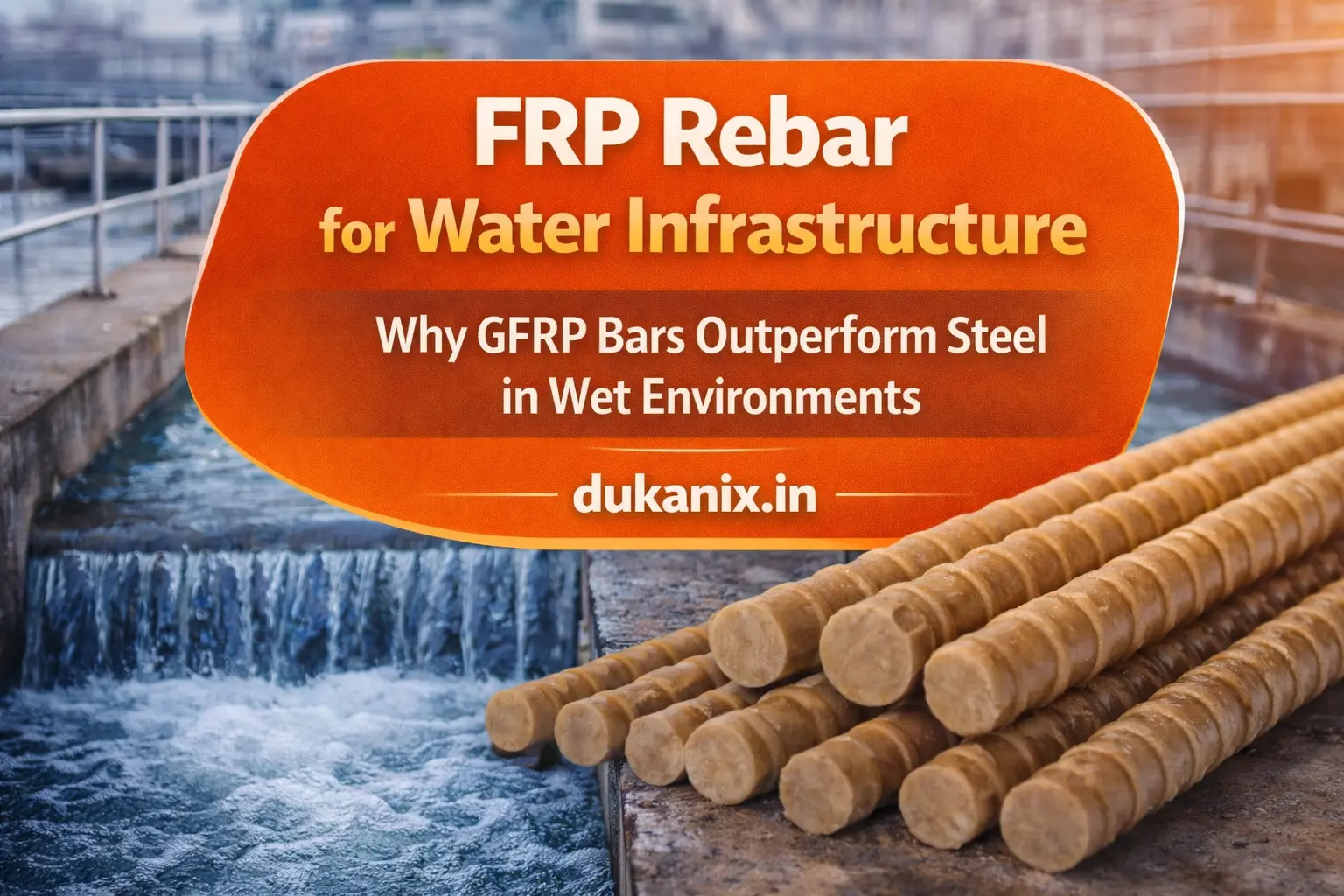
Why Water Infrastructure Needs Corrosion-Resistant Reinforcement
Water treatment plants, sewage treatment structures, drainage channels, irrigation canals, and underground utility corridors are among the most corrosion-demanding environments in civil construction. Steel rebar embedded in these structures is in continuous contact with moisture — and in treatment infrastructure, with chlorine, sulfates, and other chemicals that accelerate corrosion further.
The consequence is predictable: steel corrodes, expands as it rusts, cracks the surrounding concrete, and forces costly repair or reconstruction well before the structure's design life is reached. GFRP (Glass Fiber Reinforced Polymer) rebar eliminates this mechanism entirely. It contains no metal, cannot rust, and maintains its structural properties in permanently wet and chemically active environments.
Sourcing GFRP Rebar for an MP Project?
Dukanix is based in Dhar, MP - your closest wholesale GFRP supplier. Get bulk pricing for your city within 24 hours.
How Steel Corrosion Damages Water Structures
Steel reinforcement corrodes when moisture and oxygen reach the bar surface through the concrete cover. In water infrastructure, the cover zone is rarely fully dry — creating sustained conditions for corrosion to progress.
As steel rusts, iron oxide forms around the bar. Iron oxide occupies approximately three times the volume of the original steel. This expansion creates internal tensile stress in the surrounding concrete, causing the cover to crack and eventually spall. Once the cover cracks, moisture and chemicals reach the bar faster, accelerating the process.
In water treatment environments, chlorides from treatment chemicals penetrate concrete and attack the passive oxide layer that normally protects steel, initiating corrosion even in well-constructed structures with adequate cover depth.
How GFRP Rebar Solves the Problem
Zero corrosion in permanently wet conditions
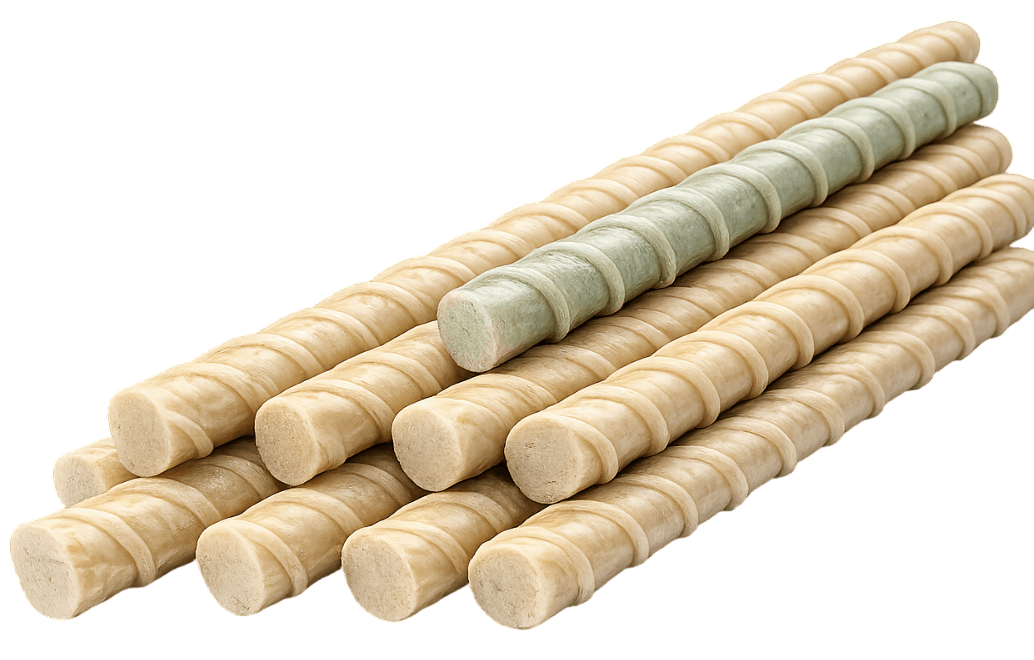
GFRP bars are manufactured from glass fibres embedded in a polymer resin matrix. Neither component is metallic. There is no electrochemical corrosion mechanism — GFRP bars do not rust regardless of moisture exposure, chloride concentration, or contact duration. A GFRP-reinforced water structure will not develop corrosion-driven concrete cracking.
Chemical resistance for treatment environments
The resin matrix surrounding the glass fibres provides a chemical barrier. For water treatment and sewage infrastructure where chlorine, sulfates, and acidic effluents are present, vinyl ester resin GFRP bars are specified — they offer significantly higher chemical resistance than polyester resin bars and are the correct choice for aggressive chemical environments.
Non-conductive in mixed utility infrastructure
Underground utility corridors and combined service tunnels that carry water, drainage, and electrical services benefit from GFRP's electrical non-conductivity. This eliminates galvanic corrosion risk in mixed-material environments and meets electrical neutrality requirements in sensitive service infrastructure.
Water Infrastructure Applications for GFRP Rebar
Water treatment plants
Tanks, channels, filter beds, sedimentation basins, and clarifier structures in water treatment plants are continuously exposed to water and treatment chemicals. GFRP bars are specified for these structures to eliminate the maintenance cycle associated with steel corrosion in treatment environments.
Sewage and effluent treatment structures
Aeration tanks, sludge handling structures, inlet channels, and outlet works in sewage treatment plants involve some of the most chemically aggressive reinforcement environments in civil construction. Vinyl ester GFRP bars maintain structural integrity in these conditions where steel reinforcement typically shows distress within 10–15 years.
Drainage channels and culverts
Urban drainage channels, stormwater culverts, and roadside drainage structures are in permanent or recurring contact with water. GFRP reinforcement in these structures eliminates corrosion-driven cracking and extends the maintenance-free service period significantly compared to steel-reinforced equivalents.
Underground water mains and service ducts
Reinforced concrete pipe surrounds, thrust blocks, and service duct structures in underground water distribution benefit from GFRP's corrosion resistance in saturated soil conditions where steel deterioration rates are accelerated by groundwater chemistry.
Irrigation canals and water channels
Canal lining structures and water channel reinforcement designed for agricultural irrigation involve decades of water exposure. GFRP bars provide maintenance-free reinforcement across the full design life — eliminating the repair cycles that affect steel-reinforced irrigation structures in permanently wet soil and water contact conditions.
Specifying GFRP for Water Infrastructure
Resin type selection
Two resin types are available for GFRP bars:
- Vinyl ester resin — Higher chemical resistance. Specify for water treatment, sewage, and any structure with direct chemical exposure. This is the correct specification for treatment infrastructure.
- Polyester resin — Suitable for general civil construction with moisture exposure but without aggressive chemical contact. More cost-effective for drainage and irrigation applications.
Bar diameter and spacing
GFRP bars for water infrastructure are typically specified in the 10mm to 16mm range for primary reinforcement, with 8mm used for secondary and distribution reinforcement in thinner sections. Bar spacing and diameter are determined by the structural engineer's design — do not substitute steel rebar tables for GFRP specifications.
Concrete cover requirements
One of the advantages of GFRP reinforcement in water structures is that reduced concrete cover can potentially be specified because the corrosion mechanism driving minimum cover requirements for steel does not apply. This should be confirmed with the project's structural engineer and specified in accordance with the relevant design standard.
Cost Comparison: GFRP vs Steel for Water Infrastructure
GFRP bars have a higher upfront material cost than equivalent steel rebar. However, for water infrastructure assessed on a whole-lifecycle basis, the comparison changes significantly:
- Steel-reinforced water structures typically require first repair intervention within 15–20 years due to corrosion-driven cracking
- GFRP-reinforced structures in the same environments have no equivalent corrosion-driven repair requirement
- Repair costs for spalled concrete on water infrastructure — access, dewatering, concrete removal, recoating — are high relative to the original construction cost
- For publicly funded water infrastructure designed for 40–60 year service lives, the lifecycle cost case for GFRP is well-established in international infrastructure procurement
Conclusion
GFRP rebar is the technically correct reinforcement choice for water treatment, sewage, drainage, and irrigation infrastructure — environments where steel corrosion is not a risk to be mitigated but a certainty to be eliminated. Vinyl ester resin GFRP bars provide corrosion-free, chemically resistant reinforcement that maintains structural integrity across the full design life of water infrastructure without the maintenance cycles associated with steel.
Explore our FRP Construction Bars for water infrastructure applications, or contact our team for project-specific bulk pricing.
Frequently Asked Questions
Quick answers related to this article.
Sourcing GFRP Rebar for an MP Project?
Dukanix is based in Dhar, MP - your closest wholesale GFRP supplier. Get bulk pricing for your city within 24 hours.
Related Blogs
How to Protect Crops from Nilgai Using Solar Fencing | FRP Rod Farm Fencing
03 Apr 2026
Read Article
How to Install FRP Rebar: Step-by-Step Guide for Construction Projects
21 Mar 2026
Read Article
FRP Rebar Lifespan and Durability: How Long Does GFRP Rebar Last?
19 Mar 2026
Read Article